

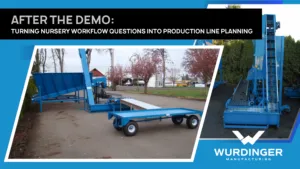
After the Demo: Turning Nursery Workflow Questions Into Production Line Planning
Meta description: An equipment demonstration can reveal larger nursery workflow opportunities. Learn how to turn questions about labor, bottlenecks, production volume, and equipment into a practical production line plan.
An equipment demonstration gives you a chance to see a machine in action. You can watch materials move through it, evaluate the controls, ask about capacity, and picture how it might fit into your nursery.
The most valuable part of a demonstration, though, is often the conversation it starts.
Where is your team losing time now? What happens immediately before and after this part of production? Would solving one bottleneck create another somewhere else? How much volume does the system need to handle during your busiest season?
Those questions are the beginning of production line planning.
A Demo Shows What the Equipment Can Do
A demonstration helps you understand the capabilities of a piece of equipment. Depending on what you are evaluating, you may be looking at:
- Production capacity
- Speed and consistency
- Staffing requirements
- Adjustability
- Changeover time
- Material handling
- Maintenance access
- Safety features
- Compatibility with different products or container sizes
These details matter, but they need to be considered within the larger operation.
A machine can perform well during a demonstration and still be the wrong fit for your nursery if it does not connect effectively with your existing workflow. Adding a faster machine will not help much if employees cannot supply it with materials or move finished products away from it quickly enough.
The equipment needs to support the full process, not just one step.
Start With the Current Workflow
Before planning a new production line, document what is happening now.
Follow the product or material through the process from beginning to end. Look at where it starts, how many people handle it, how far it travels, where it waits, and where production slows down.
Ask questions such as:
- Which steps require the most manual handling?
- Where does material pile up or sit idle?
- Which process controls the speed of everything after it?
- Where are employees walking, lifting, carrying, or repositioning products?
- Which jobs are difficult to staff during peak season?
- How often does the team stop for adjustments or changeovers?
- What equipment regularly causes downtime?
- Are there tasks that depend heavily on one experienced employee?
These answers give you a clearer picture of what the operation needs than equipment specifications alone.
Look beyond the machine itself. Ask how it connects to your production line systems .
Identify the Real Bottleneck
The biggest bottleneck is not always the most obvious or labor-intensive part of the operation.
A nursery may initially focus on increasing potting speed. But if the team cannot supply soil quickly enough, stage plants efficiently, or move completed pots away from the line, a faster potting machine may not produce the expected improvement.
A complete workflow review looks at:
- How materials arrive
- How materials are prepared
- How they enter the production process
- How products move between stages
- How finished products are handled
- How the equipment is cleaned, maintained, and reset
The individual machines should work together as a system. Otherwise, improving one step may simply move the slowdown to another part of the line.
For help identifying and addressing workflow bottlenecks, Wurdinger’s planning production line improvements resources can provide additional guidance.
Plan Around Real Production Numbers
Production planning should be based on actual operating conditions.
Estimate your current hourly and daily output, then compare those numbers with what you need during your busiest periods. Consider the full range of products you run, not just the easiest or most common item.
Useful planning information includes:
- Current production volume
- Desired production volume
- Seasonal peaks
- Container or product sizes
- Soil and material requirements
- Available employees
- Typical shift length
- Frequency of product changes
- Available floor space
- Electrical, hydraulic, pneumatic, or water requirements
- Plans for future growth
It also helps to define what success would look like.
Are you trying to produce more with the same number of people? Reduce lifting and repetitive work? Improve consistency? Shorten changeover time? Make it easier to train seasonal employees? Prepare for future growth?
Different goals may lead to different equipment recommendations.
Look at What Comes Before and After the Machine
One of the most common planning mistakes is focusing on a single machine without addressing the processes around it.
A potting machine may need a soil supply system, conveyors, controls, staging space, and an efficient way to move completed pots. A sorting or grading system may require changes to product feeding, collection, packaging, or storage.
During planning, consider:
- How materials will enter the equipment
- How completed products will leave it
- Whether the next stage can keep up
- Whether employees have enough room to work safely
- How the system will be cleaned and serviced
- Whether the equipment can be adjusted for different products
- Whether the layout allows for future expansion
These questions help prevent a new machine from creating unexpected problems elsewhere.
Consider what the machine requires from your team and facility. Ask about power, space, and how it integrates with your existing nursery equipment .
Decide Whether to Build the System All at Once or in Phases
Not every operation needs to complete an entire production line project at one time.
A phased plan may allow you to address the most urgent bottleneck first while preparing for future additions. The important part is making sure each phase supports the larger plan.
For example, the first phase might improve soil delivery or replace an unreliable machine. A later phase could add conveyors, automation, sorting equipment, or additional capacity.
Planning the full direction early can help you avoid purchasing equipment that will be difficult to integrate later.
Wurdinger offers financing options to support phased investments and help customers manage equipment and system costs over time.
Include Service and Maintenance in the Plan
Production equipment needs to remain practical after installation.
When evaluating a system, think about:
- Access to wear parts
- Availability of replacement components
- Hydraulic and electrical service needs
- Cleaning requirements
- Preventative maintenance
- Troubleshooting support
- Future modifications
- Ease of servicing the equipment
A system that is easy to maintain can reduce downtime and help protect the value of your investment.
Turn the Demo Into a Production Conversation
The next step after an equipment demonstration does not always need to be an immediate equipment order.
It may be a conversation about your workflow.
Bring your production numbers, equipment list, photos, measurements, and the questions that came up during the demonstration. From there, the discussion can move from what one machine does to what your operation actually needs.
Wurdinger Manufacturing designs complete production line systems around the way farms and nurseries work. Our team can help evaluate your workflow, identify bottlenecks, and determine whether the right solution is a new system, an equipment upgrade, a custom component, or a phased production plan.
Ready to talk through your nursery production workflow? Contact Wurdinger Manufacturing to start planning your next equipment or production system project.
Common Questions
How should a nursery start planning a production line after an equipment demo?
Before planning a new production line, document what is happening now. Follow the product or material through the process from beginning to end. Look at where it starts, how many people handle it, how far it travels, where it waits, and where production slows down.
Why look at what comes before and after the machine?
One of the most common planning mistakes is focusing on a single machine without addressing the processes around it. A potting machine may need a soil supply system, conveyors, controls, staging space, and an efficient way to move completed pots.
Should a production line be built all at once or in phases?
Not every operation needs to complete an entire production line project at one time. A phased plan may allow you to address the most urgent bottleneck first while preparing for future additions. The important part is making sure each phase supports the larger plan.